
The Silent Margin Killer Nobody Talks About
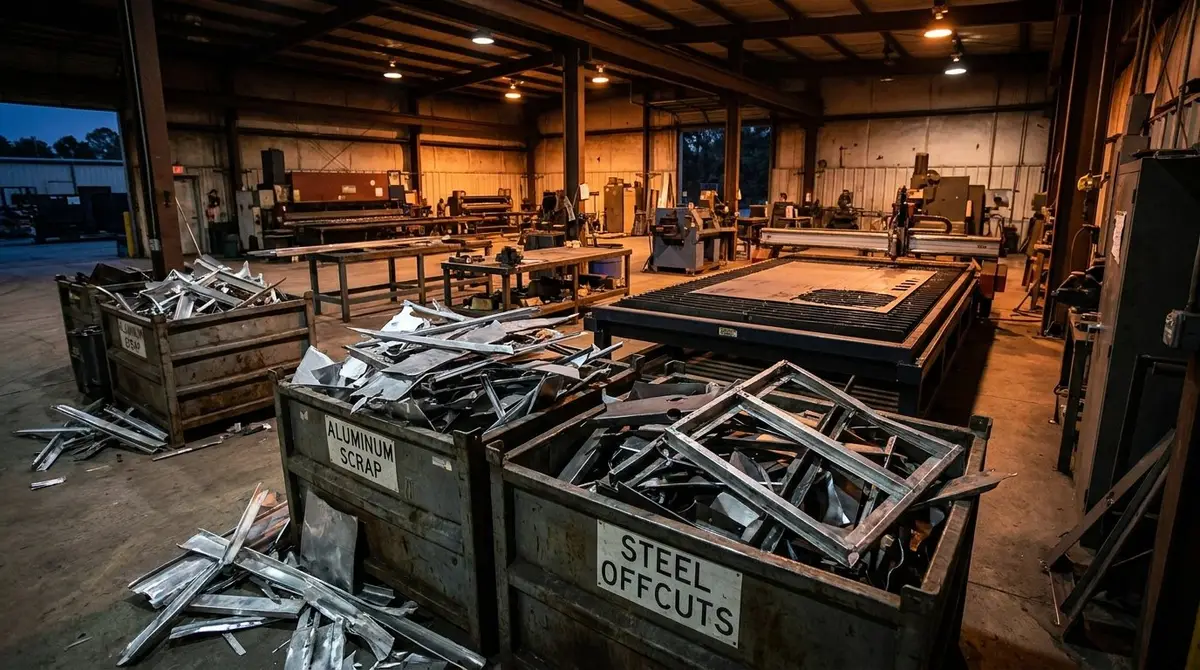
Walk into any fabrication shop at the end of a production day and you'll see it: bins overflowing with offcuts, skeletal remnants of sheet material, and geometric puzzles that didn't quite fit together. This isn't just waste—it's profit walking out the door disguised as scrap metal, wood, or composite material.
Industry studies consistently show that manufacturers operating without systematic material nesting lose between 15% and 30% of their raw material to avoidable waste. For a mid-sized shop processing $500,000 in materials annually, that's $75,000 to $150,000 in margin evaporation—often more than the net profit of the entire operation.
The math is brutal: if your material cost represents 40% of your job pricing and you're wasting 25% of that material, you've just erased 10% of your revenue before accounting for labor, overhead, or any other operational cost. In competitive markets where shops bid at 15-20% margins, material yield isn't a nice-to-have efficiency—it's the difference between profitability and insolvency.
Why Manual Nesting Fails Under Production Pressure
The traditional approach to material layout—whether done by experienced operators eyeballing cuts or engineers sketching arrangements in CAD—breaks down for three fundamental reasons that compound under real-world production conditions.
First, human spatial optimization hits cognitive limits fast. Arranging five rectangular parts on a sheet is manageable. Arranging twenty parts of varying geometries, with grain direction constraints, kerf allowances, and edge-distance requirements, exceeds what even skilled professionals can optimize mentally. The operator makes a "good enough" layout and moves on because production deadlines don't wait for perfect nesting.
Second, manual nesting can't adapt to dynamic job mixes. A layout optimized for a batch of fifty identical parts becomes obsolete when the order changes to thirty of part A and twenty of part B. The shop either re-plans from scratch (burning engineering time) or runs the original layout and accepts the waste (burning material cost). Neither option preserves margin.
Third, there's no institutional memory. When an operator discovers an efficient layout through trial and error, that knowledge lives in their head—not in a system that can apply the same optimization to future jobs. Every new batch starts from zero, re-solving problems that were already solved last month.
The Compounding Cost of Poor Yield
Material waste doesn't just hit your P&L once—it cascades through every aspect of operations. Higher material consumption means more frequent purchasing, which increases procurement overhead and ties up working capital in inventory that will literally become scrap.
Excess scrap also creates hidden handling costs: operators spend time moving waste bins, scrap requires storage space before recycling or disposal, and environmental regulations increasingly penalize high-waste operations. Some jurisdictions now charge disposal fees based on waste volume, turning your scrap bin into a recurring expense line.
Perhaps most insidious is the competitive disadvantage. Shops with superior material yield can bid jobs 5-10% lower while maintaining the same margin—or hold pricing and enjoy significantly better profitability. In commoditized markets where customers source multiple quotes, that yield advantage directly translates to win rate.
When Material Costs Spike, Yield Becomes Survival
The material yield crisis intensifies during periods of commodity price volatility. When steel, aluminum, or plywood prices surge 40-60% in a matter of months—as they have repeatedly in recent years—manufacturers face an impossible choice: absorb the cost increase and destroy margins, or pass it to customers and risk losing business.
Shops with poor material yield get hit twice: they pay the higher commodity price and they waste more of that expensive material. A 25% waste rate on $100/sheet material is painful; the same waste rate on $160/sheet material during a price spike is catastrophic.
This is why forward-thinking manufacturers treat yield optimization as a strategic hedge against commodity volatility. Improving material utilization from 75% to 90% doesn't just boost today's margins—it provides a 15-point buffer against future price shocks that competitors without optimization will absorb directly to their bottom line.
How Algorithmic Nesting Changes the Economics
Computational cut optimization fundamentally alters the material yield equation by solving the nesting problem as a mathematical optimization rather than a human approximation. Modern algorithms evaluate thousands of potential arrangements in seconds, testing configurations that would take operators hours to consider manually.
The software accounts for variables humans struggle to juggle simultaneously: grain direction, kerf width, minimum edge distances, part rotation constraints, and multi-sheet optimization across entire job batches. It doesn't get tired, doesn't settle for "good enough," and doesn't forget successful patterns from previous runs.
Real-world implementations consistently demonstrate 12-20% improvement in material utilization within the first month of deployment. For the $500K material-spend shop mentioned earlier, that's $60,000 to $100,000 in annual savings—often paying for the entire business software stack several times over while simultaneously improving delivery speed and reducing procurement complexity.
Connecting Yield to the Broader Production System
Material optimization doesn't exist in isolation—it's most powerful when integrated with production planning, procurement, and job costing. When your cut optimizer talks to your bill of materials, which connects to your purchase orders, which feeds your inventory system, you create a closed loop that prevents waste at every stage.
This is where JellyMachine's Jelly Flow enterprise production tracking changes the game. The platform's Cut Optimizer doesn't just nest parts efficiently—it does so within the context of your actual production workflow. The BOM defines what needs to be cut, the optimizer determines the most efficient layout, and that plan flows directly to procurement (generating accurate purchase orders for exactly the material you need) and then to the shop floor stations where operators execute the optimized cuts.
Because Jelly Flow tracks material through the entire procurement-to-production flow—from BOM to PO to OC (order confirmation) to BOL (bill of lading) to inventory to consumption—you gain visibility into actual yield versus planned yield. When a batch runs with higher scrap than the optimizer predicted, the system surfaces that variance immediately, allowing you to investigate whether it's a tooling issue, operator error, or material quality problem.
The result is a continuous improvement cycle: better nesting reduces waste, better tracking reveals remaining inefficiencies, and tighter integration between planning and execution prevents the disconnect that creates scrap in the first place. Your material yield becomes a managed metric rather than an accepted cost of doing business.
From Scrap Bin to Profit Center
The material yield crisis isn't a technology problem—it's a system problem. Manufacturers have accepted 20-30% waste as inevitable because manual nesting, disconnected procurement, and blind production execution made it structurally impossible to do better.
But when cut optimization integrates with production tracking, inventory management, and procurement planning, the economics flip. Material becomes a controlled input rather than a variable cost. Margins stabilize even when commodity prices swing. Competitive bids become possible without sacrificing profitability.
The shops winning in today's margin-compressed manufacturing environment aren't the ones with the newest CNC machines or the lowest labor costs—they're the ones who stopped leaving 30% of their profits in the scrap bin and started treating material yield as the strategic advantage it actually is.