
Most manufacturers run two separate worlds: the shop floor tracks work orders, station phases, and operator progress in one system, while the office manages quotes, invoices, and customer communication in another. Between these worlds sits a gap filled with spreadsheets, phone calls, and manual data re-entry.
This disconnection costs time, introduces errors, and delays the moment you can invoice completed work. When production data lives in isolation from your billing system, you're effectively running your business with one hand tied behind your back.
The Hidden Cost of Disconnected Systems
Consider a typical custom manufacturing workflow: a sales rep creates a quote, the customer accepts, production receives a printed work order, operators complete phases at various stations, someone manually checks progress, and finally—days or weeks later—accounting creates an invoice by re-entering job details, labor hours, and materials used.
Every handoff is an opportunity for error. The quote says 40 hours; production logged 47. Material costs changed mid-job but nobody updated the estimate. A rush order completed Friday doesn't get invoiced until the following Wednesday because the production manager was out.
These aren't edge cases—they're daily realities that erode margins and frustrate teams.
What Integration Actually Looks Like
When production tracking and billing share the same foundation, the entire workflow transforms. A unified system means the moment a quote converts to a job, that same record flows directly to the shop floor. Operators see exactly what was promised. Station phases map to the original scope. Progress updates in real time.
More importantly, when the last phase completes, all the data needed for invoicing already exists: actual labor hours by station, materials consumed, any change orders approved along the way. No re-entry. No hunting through paper logs. No waiting for someone to compile information from three different sources.
Kanban Pipelines Meet Shop Floor Stations
The most effective unified systems use visual tools that work for both sales and production teams. Kanban-style pipelines let you track customer opportunities from lead to quote to active production. Each card represents a customer relationship, but it also becomes the container for production tracking.
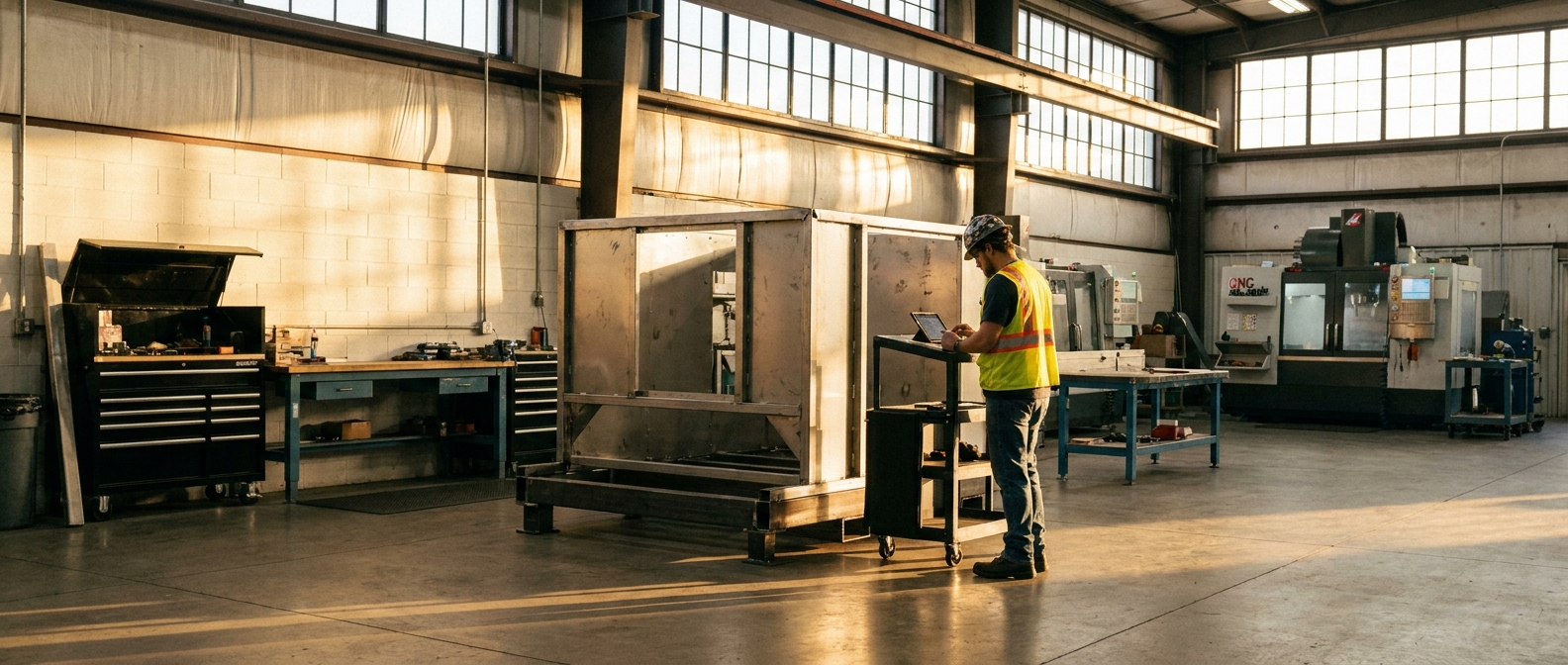
When a deal moves to "In Production," that same card links to shop-floor station phases. The welding station, assembly station, and finishing station all report progress against the same job record. Production managers see status on tablets at each station. Sales reps see the same progress when customers call asking for updates.
This isn't theoretical—it's how modern manufacturing operations eliminate the artificial boundary between customer management and production execution.
Faster Cash Flow
The financial impact of integration shows up most clearly in days-to-invoice. When billing waits on manual data compilation, you're essentially providing free financing to customers. Completed jobs sit unbilled for days or weeks.
With unified tracking, invoices can generate the moment production marks a job complete—or even automatically based on phase completion rules. The system already knows what was quoted, what was actually done, and what materials were used. Creating an accurate invoice becomes a one-click action instead of a half-day project.
Audit Trails and Accountability
Integrated systems also create natural audit trails. When did the customer approve the quote? Who marked the welding phase complete? When did materials get pulled from inventory? What change orders were approved and by whom?
This traceability matters during customer disputes, quality investigations, and financial audits. Instead of reconstructing timelines from emails and paper logs, the entire job history lives in one place with timestamps and user attribution.
The Command Center View
For managers and owners, unified production and billing data enables something impossible with disconnected systems: a real-time command center view of the entire operation.
See which jobs are running late against their quoted timelines. Identify bottleneck stations where work is piling up. Track actual costs versus estimates across all active jobs. Forecast cash flow based on jobs nearing completion. All from a single dashboard, because all the data lives in one system.
This visibility transforms reactive firefighting into proactive management. You spot problems while there's still time to fix them, not after they've already impacted customer satisfaction or profitability.
Building Toward Integration
Moving from disconnected tools to a unified system doesn't require ripping out everything and starting over. The key is choosing a platform designed from the ground up to connect customer management, production tracking, and billing—not bolted-together integrations between separate products.
Look for systems where customer pipelines, shop-floor station tracking, and quote-to-invoice workflows share the same data model. Where a "job" means the same thing to sales, production, and accounting. Where updates in one area immediately reflect everywhere else without syncing delays or integration failures.
Modern manufacturing operations deserve modern tools that reflect how work actually flows: from customer conversation to shop floor execution to getting paid. When those pieces connect seamlessly, everything gets faster, more accurate, and more profitable.
If you're tired of maintaining separate worlds for production and billing, JellyMachine offers an all-in-one business OS that unifies Kanban CRM pipelines with enterprise production tracking (Jelly Flow) and quote-to-invoice workflows. Learn more at jellymachine.com.