
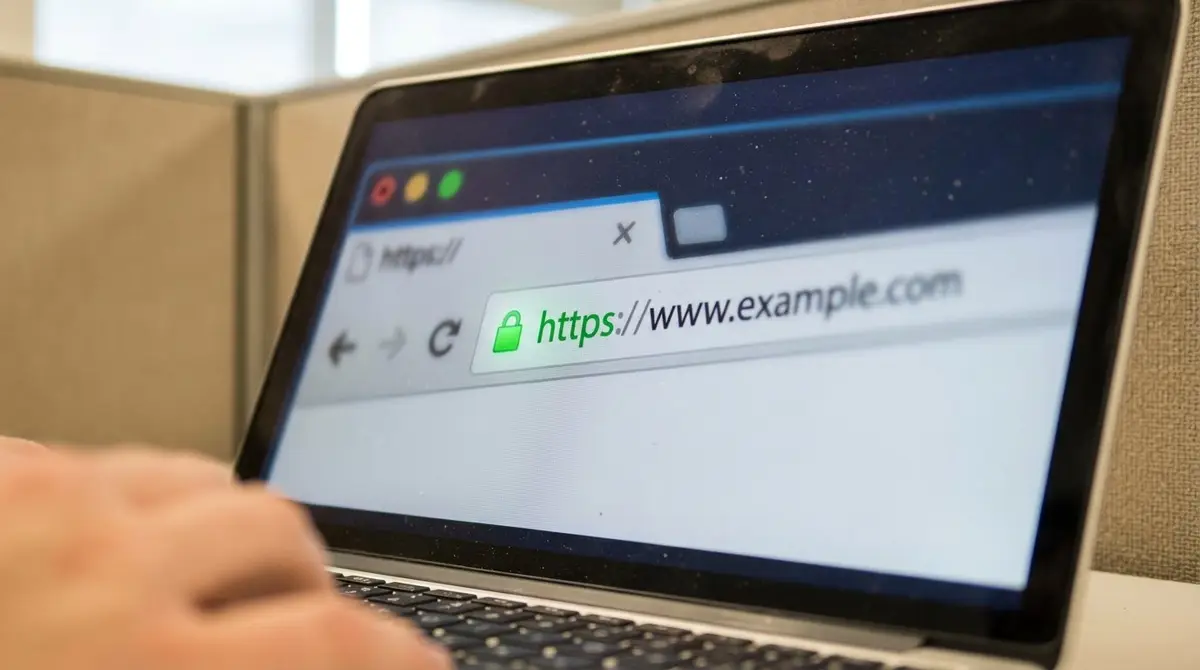
The Browser Warning That Kills First Impressions
A potential customer clicks your link. Before they see your headline, your value proposition, or your product photos, their browser displays a stark warning: "Not Secure." In the address bar, where a reassuring padlock should appear, there's a red triangle or an open lock icon.
That visitor doesn't know what SSL certificates are. They don't understand the technical difference between HTTP and HTTPS. What they do understand is the message their browser just delivered: this site is not safe. And in that split second, you've lost credibility you can never recover.
This isn't a theoretical problem. Since 2018, Chrome—which commands over 60% of browser market share—has flagged all HTTP sites as "Not Secure." Firefox, Safari, and Edge followed suit. The web has moved to HTTPS as the default standard, and businesses without SSL certificates are now the exception that triggers warnings.
What SSL Certificates Actually Do
An SSL (Secure Sockets Layer) certificate creates an encrypted connection between a visitor's browser and your web server. When someone visits an HTTPS site, their browser and your server perform a cryptographic handshake that ensures two things:
- Data encryption: Information transmitted between browser and server is scrambled, preventing interception by third parties on the network path.
- Identity verification: The certificate proves your server is actually who it claims to be, preventing impersonation attacks.
For business websites, the encryption matters less than the trust signal. Most business sites don't handle credit card data or sensitive personal information on every page. But the padlock icon and HTTPS prefix have become universal symbols of legitimacy. Their absence is now interpreted as negligence or worse.
The SEO Penalty You Can't See
Google announced HTTPS as a ranking signal in 2014. While the company downplayed its weight initially, the preference has only strengthened. In 2025, HTTPS is not a tiebreaker—it's table stakes.
Search Console data shows that Google actively prioritizes HTTPS versions of pages when indexing. If your site runs on HTTP while competitors use HTTPS, you're fighting an uphill battle for visibility. The algorithm doesn't just prefer secure sites; it actively warns users away from insecure ones in search results for certain queries.
Beyond rankings, SSL affects crawl behavior. Google's bots spend limited time on each site. When they encounter mixed content warnings, redirect chains between HTTP and HTTPS versions, or certificate errors, they may crawl less efficiently or skip pages entirely. You're not just losing ranking points—you're losing coverage.
The Conversion Impact of Trust Signals
Baymard Institute research on checkout abandonment consistently shows security concerns as a top-three reason users don't complete purchases. While that study focuses on eCommerce, the principle extends to all conversion actions: form submissions, quote requests, account creation, file downloads.
When a browser flags your site as "Not Secure," it doesn't distinguish between a contact form and a payment form. The warning appears regardless. And users don't make fine distinctions either. If the browser says it's not safe to be here, why would they trust you with their email address, phone number, or business details?
The trust deficit compounds for B2B sites. A procurement manager researching vendors sees that warning and immediately questions your technical competence. If you can't secure your own website properly, how will you handle their data, their orders, their production schedules?
The Certificate Complexity Myth
Ten years ago, obtaining and installing an SSL certificate required technical knowledge, manual CSR generation, validation emails, and annual renewal fees. That friction kept many small business sites on HTTP longer than they should have been.
Today, that complexity is gone. Let's Encrypt—a free, automated certificate authority—has issued over 3 billion certificates since 2016. Modern web platforms handle certificate provisioning, installation, and auto-renewal without user intervention. When you connect a custom domain, the SSL certificate should appear within minutes, not days.
The technical barrier has collapsed. The only remaining obstacle is awareness—businesses that don't realize HTTPS is now mandatory, or platforms that still treat SSL as an optional upgrade rather than a default feature.
When SSL Is Built In, Not Bolted On
The difference between platforms becomes clear at domain connection time. On legacy systems, you might navigate through settings panels, upload certificate files, configure DNS records manually, and wait for propagation. On modern platforms, you enter your domain name and the system handles the rest.
JellyMachine's AI website builder provisions SSL certificates automatically when you connect a custom domain. There's no separate SSL toggle, no upgrade tier, no manual configuration. HTTPS is the default because there's no legitimate reason to run a business website without it in 2025. The certificate renews automatically every 90 days, invisible to you, ensuring the padlock never disappears.
This isn't a premium feature—it's baseline infrastructure. The same way you expect your website to load without manually configuring server memory allocation, you should expect HTTPS to work without thinking about certificate chains and private keys.
The Real Cost of Cutting Corners
Some businesses still run HTTP sites because their current platform charges extra for SSL, or because migration seems complicated, or because "it's worked fine so far." But the cost of that decision is no longer theoretical.
Every visitor who sees a "Not Secure" warning is a potential customer who now doubts your professionalism. Every search query where your HTTP page loses to a competitor's HTTPS page is revenue you'll never see. Every form submission you don't receive because someone didn't trust the security warning is a lead that goes to someone else.
The web has moved on. HTTPS is not a nice-to-have security enhancement—it's the minimum standard for being taken seriously online. Your business deserves infrastructure that meets that standard without making you think about it.